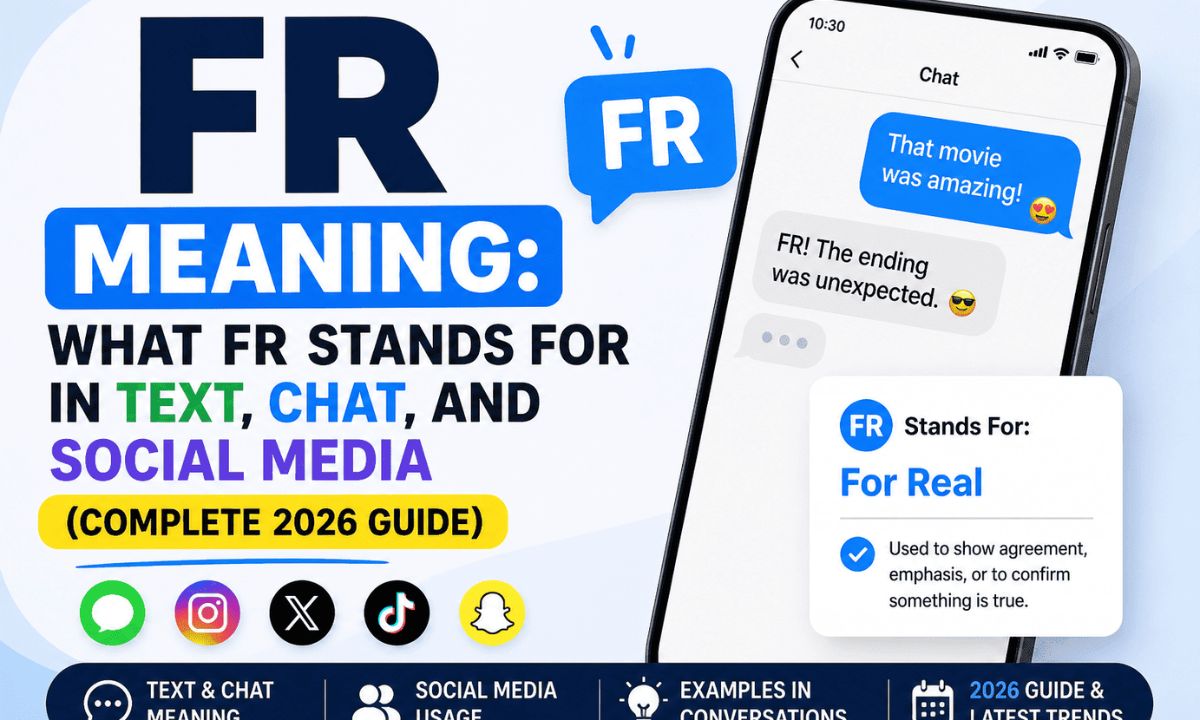
If you’ve scrolled through TikTok comments, received a text message from a friend, or read through a Reddit thread lately, you’ve almost certainly come across “FR.” It’s everywhere — tucked at the end of sentences, standing alone as a reaction, or doubled up as “FRFR.” And yet, for many people — parents, professionals, or anyone who didn’t grow up in the Gen Z era of hyper-abbreviated digital communication it can stop you in your tracks.
So, what does FR mean, exactly? Where did it come from? Is it always the same thing, or does the meaning shift depending on context? And are there situations where using it would be completely inappropriate?
This guide answers all of that and more. You’ll learn the full story of FR — its primary meaning, alternate definitions across industries, how it’s used on specific platforms like TikTok, Snapchat, and Instagram, and what related slang terms you should know. Whether you’re a curious parent, a non-native English speaker, a content creator, or simply someone who got lost in a group chat, this is your complete reference.
What Does FR Mean? The Quick Answer
FR stands for “For Real.”
In digital communication — text messages, social media comments, online chat rooms, gaming lobbies, and direct messages — “FR” is a shorthand way of expressing sincerity, agreement, or strong emphasis. It’s the digital equivalent of saying “I’m serious,” “honestly,” or “that’s so true” in everyday conversation.
It’s one of the most concise yet emotionally loaded pieces of internet slang in use today. Two letters. Enormous range of meaning depending on tone.
FR Meaning: Breaking It Down
| Term | Full Form | Primary Use |
|---|---|---|
| FR | For Real | Expressing sincerity, agreement, or emphasis |
| FRFR | For Real, For Real | Stronger, more intense version of FR |
| FR? | For Real? | Expressing disbelief or asking for confirmation |
| No Cap FR | No Cap, For Real | Absolute honesty, double emphasis |
| FR tho | For Real Though | Genuine emphasis, slightly softer tone |
The Origin and History of FR
Where Did “For Real” Come From?
The phrase “for real” has been part of casual American English speech for decades. Historical records suggest the expression appeared in American newspapers as far back as the 1920s. Its roots lie in informal spoken language — especially within African American vernacular English (AAVE), where “for real” was commonly used to affirm truth and sincerity in conversation.
As the phrase made its way into everyday American speech and popular culture — through music, television, and film — it became widely recognized across demographics.
How “For Real” Became “FR”
The abbreviation “FR” emerged naturally from the culture of early internet communication. In the late 1990s and early 2000s, chat rooms and instant messaging platforms like AIM, Yahoo Messenger, and MSN Messenger encouraged users to type faster by cutting words down to their shortest possible form. That’s how “laugh out loud” became “LOL,” “be right back” became “BRB,” and “for real” became “FR.”
As platforms like Twitter (now X) introduced character limits, the need for short, punchy expressions only grew stronger. “FR” fit perfectly — it conveyed a full emotional statement in just two characters.
The Rise Through Social Media
FR gained widespread cultural momentum between 2010 and 2020. Twitter and Vine were early accelerators, bringing short-form, casual, reaction-based content into the mainstream. When Vine’s vine-style culture moved to TikTok around 2016–2018, “FR” came along with it.
Hip-hop culture played a significant role as well. Artists and performers who regularly used “for real” in their lyrics and interviews helped normalize the term across broader audiences. As their music and content reached millions, so did the slang embedded in it.
By the early 2020s, “FR” was not just a Gen Z artifact — it had spread to Millennials, and even some older demographics had picked it up through exposure to digital culture.
How FR Is Used: Context, Tone, and Function
One of the most important things to understand about “FR” is that it’s not one-dimensional. Its meaning shifts depending on where it appears in a sentence, what punctuation follows it, and the emotional context of the conversation.
1. Expressing Genuine Agreement
This is the most common use. When someone says something you genuinely agree with, “FR” signals that you’re not just nodding along — you actually feel the same way.
Example:
Person A: “The new season of that show was so disappointing.” Person B: “FR. The writing went completely downhill.”
Here, “FR” confirms shared feelings. It’s sincere, not ironic.
2. Emphasizing Your Own Statement
“FR” can be added at the end of your own sentence to signal that you’re completely serious about what you just said — not joking, not exaggerating.
Example:
“I haven’t slept properly in three days, FR.” “That sandwich was the best thing I’ve eaten this year, FR.”
In both cases, “FR” prevents the listener from thinking the speaker is being dramatic for effect. It’s a stamp of authenticity.
3. Expressing Disbelief or Asking for Confirmation
When “FR” is followed by a question mark, it flips its function entirely. Instead of affirming, it’s questioning.
Example:
“She got promoted after only three months?” “FR?!”
This usage says: “Wait — are you being serious right now? Is that actually true?” It’s the verbal equivalent of a shocked face emoji.
4. Reacting to Relatable Content
On platforms like TikTok and Twitter, “FR” functions as a reaction in comment sections. If someone posts something that resonates deeply — a frustration, a funny observation, a shared experience — “FR” in the comments means “this is exactly how I feel.”
Example:
TikTok caption: “When your alarm goes off and you’ve only slept 4 hours” Top comment: “FR every single morning”
5. Sarcastic or Dismissive Use
Though less common, “FR” can be used sarcastically when paired with a dismissive tone or specific emoji.
Example:
“Oh yeah, totally fr”
In this context, the sarcasm flips the meaning — the speaker is actually disagreeing or mocking.
FR Meaning Across Different Social Media Platforms
Understanding how “FR” is used on each platform helps you read it correctly in context.
FR Meaning on TikTok
TikTok is one of the primary drivers of FR’s current popularity. It appears constantly in video comments, captions, and reply threads. Since TikTok’s algorithm rewards highly relatable content, comment sections become places where users affirm shared experiences — and “FR” is the go-to tool for that.
You’ll commonly see it in reaction comments like “FR this hits different” or simply “FR” under emotional or funny videos.
FR Meaning on Snapchat
On Snapchat, where conversations happen quickly and privately, “FR” serves as a rapid emotional signal between friends. Because Snap conversations are often fast-paced and casual, abbreviated expressions like “FR” help maintain conversational momentum.
Users often use it to confirm plans (“I’ll be there at 8, FR”), agree with gossip, or respond to news with emphasis.
FR Meaning on Instagram
Instagram users drop “FR” in comment sections under posts, reels, and stories. It’s especially common under posts dealing with relatable humor, lifestyle content, and social commentary. When influencers or accounts post things their audience deeply connects with, “FR” in the comments functions as a digital nod of recognition.
FR Meaning on Twitter / X
Twitter — with its historical character limits and culture of hot takes and reactions — helped establish “FR” as mainstream digital language. The platform’s fast, punchy culture made two-letter responses feel completely natural. “FR” often appears as a standalone reply tweet or at the end of a quote-tweet to add emphasis.
FR Meaning on Reddit
Reddit communities, especially in subreddits populated by younger users, use “FR” in comment replies. It signals authentic agreement with a post or comment and helps create a sense of communal validation within threads.
FR Meaning in Gaming (Discord, Twitch)
Gaming culture has its own dialect of internet slang, and “FR” fits right in. On Discord servers and Twitch chats, it’s used to react to impressive plays, commiserate over difficult opponents, or agree with someone’s game strategy critique. Fast-moving chat environments make short expressions essential.
FR vs. FRFR: What’s the Difference?
| Expression | Meaning | Intensity |
| FR | For Real | Standard emphasis, sincere |
| FRFR | For Real, For Real | Stronger, more passionate |
| FR tho | For Real Though | Slightly softened, conversational |
| FR no cap | For Real, No Cap (No Exaggeration) | Maximum honesty |
“FRFR” doubles down on sincerity. Where “FR” is saying “I’m serious,” “FRFR” is saying “I absolutely, completely, 100% mean this.” Think of it like the difference between saying “I love this song” and “I genuinely cannot stop listening to this song.”
FRFR Example:
“That performance was incredible, FRFR. One of the best things I’ve ever watched.”
The repetition is intentional — it removes any remaining doubt that the speaker might be joking or exaggerating.
All the Different Meanings of FR (Beyond “For Real”)
While “For Real” is the dominant meaning of FR in casual digital communication, the abbreviation has several other meanings depending on context, industry, and field. Here’s a comprehensive breakdown.
FR Meaning in Different Fields
| Context | FR Stands For | Example Use |
| Internet Slang | For Real | “That’s crazy, FR” |
| Safety / Industrial | Flame Resistant | FR clothing in welding |
| Chemistry | Francium (Fr) | Element 87 on the periodic table |
| Geography / Country Code | France | .fr domain, fr-FR language code |
| Religion / Titles | Father | Fr. Thomas (Catholic priest) |
| Real Estate | For Rent | FR — 2BR apartment available |
| Finance | Financial Report | Q3 FR released today |
| Transportation | Flat Rack | FR container on cargo ship |
| Technology | Frame Relay | FR protocol in networking |
| Safety Standards | Fire Resistant | FR-rated door in construction |
| Automotive | Front Right | FR wheel alignment |
| Military / Electronics | Frequency Response | FR graph for audio |
FR as Flame Resistant
In industries like electrical power, oil and gas, metal fabrication, and welding, “FR” is a critical safety designation. FR clothing — flame-resistant workwear — is designed to self-extinguish quickly when exposed to flame, significantly reducing burn injuries.
The Occupational Safety and Health Administration (OSHA) has specific regulations governing the use of FR clothing under standard 29 CFR 1910.269, which covers electric power operations. Companies that fail to provide proper FR gear can face serious legal consequences.
If you work in a safety-related field and encounter “FR,” context makes it immediately clear you’re not in slang territory.
FR as Francium
In chemistry, Fr is the symbol for francium — atomic number 87 on the periodic table. It’s a highly radioactive, extremely rare alkali metal. The element was named after France, where its discoverer, Marguerite Perey, was from. Outside of a chemistry classroom or academic context, you’re unlikely to encounter this meaning in everyday conversation.
FR as France / French
In internet domain names and language codes, “FR” denotes France and the French language. Websites ending in “.fr” belong to French domains. The official language-country code for French is “fr-FR.” If you see “FR” on a formal website, government document, or language setting, this is almost certainly the meaning being used.
FR as Father
In religious contexts — particularly within the Catholic Church — “Fr.” is a standard abbreviated title for a priest. You might see it written as “Fr. Michael” or “Fr. James” before a clergyman’s name. This is one of the oldest uses of the abbreviation and has nothing to do with internet slang.
When to Use FR and When to Avoid It
Knowing when FR is appropriate is just as important as knowing what it means. Using internet slang in the wrong setting can undermine your credibility or cause confusion.
Situations Where FR Works Well
- Text messages with close friends and family
- Social media comments and replies
- Casual DMs on Instagram, Snapchat, or Twitter
- Gaming chats on Discord or Twitch
- Informal group chats among peers
- Personal captions on social media posts
- Responding to relatable memes or viral content
Situations Where FR Is Inappropriate
- Professional emails or business communication
- Academic essays, reports, or formal writing
- Cover letters or job applications
- Customer service interactions
- Formal presentations or official documents
- Communication with people unfamiliar with digital slang
The rule of thumb is simple: if you’d say “I’m serious” or “honestly” in the context, “FR” works. If you’d use formal language in the context, skip the slang entirely.
Real-Life Conversation Examples Using FR
Seeing FR in actual conversational contexts helps cement its meaning better than any definition. Here are several natural examples across different scenarios.
Agreement in a Group Chat
Maya: “I think we should move the meeting to Friday, I can’t do Thursday.” Alex: “FR, Thursday doesn’t work for me either.” Jordan: “Same, FR let’s just move it.”
Expressing Frustration
“I’ve been waiting in this line for 45 minutes, FR this is unacceptable.”
Reacting to Surprising News
“She actually won the whole competition?” “FR?! I didn’t even know she was competing!”
Emphasizing a Compliment
“Your photography is honestly some of the best work I’ve seen this year, FR.”
In a TikTok Comment Section
Video: Someone explaining why mornings are impossible without coffee Comment: “FR, I am a completely different person before my first cup”
FRFR Example
“That concert last night changed my life, FRFR. I cried twice and I’m not even ashamed.”
Sarcastic FR
“Oh sure, I’ll just magically finish all this work by 5pm. FR though, who makes these deadlines?”
Related Slang Terms You Should Know
Understanding “FR” opens a door to a broader vocabulary of digital slang. These related expressions are frequently used alongside FR or in similar contexts.
No Cap
“No cap” means “no lie” or “I’m not exaggerating.” It’s a direct assertion of honesty. Using “FR no cap” is the slang equivalent of saying “I genuinely mean this, without any exaggeration whatsoever.”
“That was the funniest thing I’ve ever seen, no cap.”
Deadass
Primarily used in American slang — especially in New York — “deadass” means the speaker is completely serious. It functions as a stronger, more emphatic version of “for real.”
“I’m deadass telling you, that movie had me in tears.”
Facts
“Facts” is used to strongly agree with something someone just said. Where “FR” confirms truth from the listener’s perspective, “Facts” validates the speaker’s statement.
“School lunches are genuinely not enough food for a full day.” “Facts.”
No Lie
A more traditional alternative to “no cap” and “FR,” “no lie” simply means the speaker is being honest.
“No lie, that was the best pizza I’ve had in years.”
Lowkey / Highkey
These terms indicate the degree of emphasis on a feeling. “Lowkey” suggests the feeling is somewhat understated or subtle; “highkey” means the emotion is strong and unapologetic.
“I’m lowkey obsessed with this new show.” “I’m highkey devastated that it ended.”
IKR (I Know, Right?)
IKR is used to agree enthusiastically with something someone said — similar to “FR” but more conversational and collaborative.
“That exam was absolutely brutal.” “IKR, I studied for days and still struggled.”
Bet
“Bet” in modern slang can mean “okay,” “agreed,” or “sounds good.” It’s used to confirm or acknowledge something, often as a quick reply.
“I’ll meet you at 7.” “Bet.”
Cap / No Cap
“Cap” means a lie or exaggeration. “No cap” means the opposite — the truth, no exaggeration. These terms come from African American Vernacular English and have been widely adopted through hip-hop culture.
How FR Fits Into the Broader Evolution of Internet Slang
FR isn’t just a word — it’s a window into how language is changing in the digital age. The evolution of internet slang follows a predictable but fascinating pattern.
Phase 1: Spoken Language
A phrase exists in everyday speech — people say “for real” naturally in conversation without thinking much about it.
Phase 2: Early Digital Adoption
Chat rooms, SMS, and early social platforms create pressure to communicate faster. Long phrases get compressed. “For real” becomes “FR” because it’s quicker to type and saves character space.
Phase 3: Cultural Amplification
Social media, music, and memes spread the abbreviated form rapidly. What started as a typing shortcut becomes a cultural expression with its own specific emotional weight.
Phase 4: Mainstream Integration
The term crosses demographic boundaries. Parents hear their children say it. Non-native English speakers encounter it in the content they consume. It shows up in marketing, journalism, and brand communication.
Phase 5: Evolution and Variation
The term spawns variations: FRFR, FR no cap, FR tho. Each variation adds a layer of nuance, extending the term’s expressive range.
FR has completed this cycle and sits firmly in Phase 4 and Phase 5 simultaneously. It’s mainstream enough that most people under 40 know it, but still evolving in how it’s used and combined with other slang.
FR and Generational Communication: Who Uses It?
Gen Z (Born 1997–2012)
Gen Z is the core demographic for FR usage. Growing up with smartphones, social media, and platforms like TikTok and Snapchat, they developed a digital-first communication style where abbreviations like FR are second nature. For Gen Z, typing “FR” instead of “for real” isn’t a conscious choice — it’s just how they talk online.
Millennials (Born 1981–1996)
Many Millennials have adopted FR through exposure to Gen Z culture, social media, and digital content. Millennials who are active on Twitter, Reddit, or Instagram are likely comfortable using and interpreting FR. Those who primarily operate in professional environments may be less familiar with it.
Gen X and Baby Boomers (Born Before 1981)
These generations are less likely to use FR naturally, but many have encountered it and can interpret it in context — especially those with teenage children or significant social media activity. Parents in particular often seek out definitions of slang their kids use online, which is part of why guides like this one exist.
Tips for Using FR Naturally
If you’re new to using FR in your messages, here are some practical tips for using it naturally without it feeling forced.
- Match the energy of the conversation. If the chat is casual and playful, FR fits naturally. If the tone is more measured or serious, consider avoiding slang.
- Don’t overuse it. Using “FR” in every message dilutes its impact. Reserve it for moments when you genuinely want to emphasize sincerity or agreement.
- Pay attention to punctuation. “FR.” (period) is an affirmation. “FR?” (question mark) is expressing disbelief or asking for confirmation. The punctuation completely changes the tone.
- Know your audience. FR works great with friends and peers in your age group. It can come across as awkward or confusing with older generations, formal contacts, or in professional settings.
- Use it where it feels natural in the sentence. FR can appear at the beginning (“FR, that was amazing.”), in the middle (“That movie was, FR, one of the best I’ve seen.”), or at the end (“That movie was incredible, FR.”). All are valid.
- Combine it intentionally. “FRFR” for extreme emphasis. “FR though” for a more conversational, thoughtful tone. “FR no cap” when you want to make absolutely clear you’re not exaggerating.
Common Mistakes to Avoid When Using FR
Even a simple two-letter abbreviation can be misused. Here are the most common pitfalls.
Using it in professional communication. This is probably the biggest mistake. Sending an email with “FR, the deadline needs to move” to your manager or client is unprofessional and confusing. Use formal language in formal contexts.
Using it sarcastically without being clear. FR can be used sarcastically, but without clear context or tone indicators (like a specific emoji or obvious situational cues), sarcasm is hard to read in text. When in doubt, be explicit.
Confusing it with other meanings of FR. If someone in your workplace is discussing FR clothing and you think they’re expressing agreement, that’s a significant misunderstanding. Always check context.
Overusing it. If every single message ends in “FR,” you’ll quickly come across as trying too hard or lacking vocabulary. Use it strategically.
Assuming everyone knows what it means. If you’re communicating with someone unfamiliar with digital slang — an older family member, a new international contact, a formal business partner — “FR” may need a translation or should be avoided altogether.
FR in Brand Communication and Marketing
Some brands — particularly those targeting Gen Z audiences — have incorporated casual slang into their marketing language. Using “FR” in a social media caption or ad copy can feel authentic and relatable when done well. However, it can also feel forced and cringeworthy when it doesn’t match the brand’s voice.
Brands that successfully use slang like FR tend to be those already deeply embedded in youth culture — streetwear companies, music brands, gaming companies, and food chains with a young demographic. For corporate brands with older customer bases, adopting slang often backfires.
The lesson: know your audience before reaching for internet slang in your marketing strategy.
Frequently Asked Questions About FR
What does FR mean in a text message? FR means “For Real” in a text message. It’s used to express sincerity, agreement, or to emphasize that the speaker is being honest about something.
What does FRFR mean? FRFR stands for “For Real, For Real” — a doubled-up, more intense version of FR used for stronger emphasis.
What does FR mean on TikTok? On TikTok, FR typically appears in comments and captions to express genuine agreement, shared emotion, or a sincere reaction to content.
What does FR mean on Snapchat? On Snapchat, FR means “For Real” and is used the same way as in text messages — to confirm sincerity or agree with something.
Is FR formal or informal? FR is entirely informal and should only be used in casual conversations. It’s not appropriate for professional emails, academic writing, or formal communication.
Can FR mean something other than “For Real”? Yes — outside of slang, FR can mean Flame Resistant (safety industry), France or French (geography/language), Francium (chemistry), Father (religious title), Financial Report (business), or For Rent (real estate).
What is “no cap FR” meaning? “No cap FR” combines two slang terms for double emphasis on honesty — it means “I’m absolutely not lying, for real.” It’s one of the strongest ways to assert you’re being sincere.
Is FR used by all age groups? FR is most common among Gen Z and Millennials. While older generations have encountered it, they’re less likely to use it naturally in their own communication.
How do you respond to FR in a conversation? Responding to FR depends on the context. If someone says “That was the best concert, FR,” you can agree with “FR, it really was.” If they say “FR?” in disbelief, you can confirm or clarify what you said.
What does “so FR” mean? “So FR” means “so for real” — an intensified version used to add even more emphasis to a statement’s sincerity. “I’m so FR exhausted right now” means the speaker is being completely serious about their fatigue.
Can FR be used alone as a response? Absolutely. “FR” as a standalone reply is one of the most common uses — it signals agreement without needing any additional words.
What is the difference between FR and “no cap”? Both signal honesty, but “no cap” specifically denies lying or exaggerating, while “FR” more broadly affirms truth and sincerity. They overlap significantly and are often used together for extra emphasis.
Summary: Everything You Need to Know About FR
FR is one of the most versatile and widely used pieces of internet slang in the digital lexicon. At its core, it stands for “For Real” — a two-letter expression that can convey agreement, sincerity, disbelief, emphasis, or genuine emotional reaction depending on context.
Its roots lie in spoken American English, its growth was accelerated by early internet culture and character-limited platforms, and its current dominance owes much to TikTok, hip-hop culture, and the broader Gen Z communication style.
Understanding FR means understanding not just a word, but a communication philosophy — one that values authenticity, speed, and emotional directness. In a world of endless digital messages, “FR” cuts through the noise in exactly two characters.
Whether you’re seeing it for the first time, trying to understand what your teenager means, brushing up on digital fluency as a content creator, or simply satisfying curiosity — you now have everything you need to understand, interpret, and use FR confidently.
And yes, this guide covered it all — FR.
Key Takeaways
- FR stands for “For Real” — it’s the primary and most common meaning in digital communication
- FR is used for agreement, emphasis, sincerity, and expressing disbelief depending on context and punctuation
- FRFR is the intensified version, meaning “For Real, For Real” — even stronger emphasis
- FR has alternate meanings including Flame Resistant, France, Father, Francium, and Financial Report — always read context
- FR is best used in casual, informal settings — never in professional or academic communication
- Gen Z and Millennials are the primary users, but the term has reached mainstream digital culture
- Related slang includes no cap, deadass, facts, IKR, and bet — all used in similar conversational contexts
- FR originated from spoken American English and AAVE, gained traction in early internet culture, and exploded through social media platforms
How FR Is Different From Similar Expressions
With so many sincerity-affirming phrases in the digital lexicon, it’s worth drawing clear distinctions between FR and its closest alternatives. Knowing the subtle differences helps you use each one appropriately and understand the nuances when you encounter them in conversation.
FR vs. TBH (To Be Honest)
“TBH” (to be honest) is often used before a statement to signal that what follows is a candid opinion or genuine feeling — especially when the statement might be unexpected or slightly uncomfortable. “FR” typically comes after or at the end of a statement to confirm its truth.
TBH example: “TBH, I didn’t think the movie was that good.” FR example: “That movie was not that good, FR.”
Both signal honesty, but TBH sets up the statement as a potentially bold opinion, while FR confirms it as sincere truth.
FR vs. NGL (Not Gonna Lie)
“NGL” is similar to TBH — it precedes a statement that the speaker is confessing might surprise people or go against expectations.
“NGL, I actually enjoyed that presentation.”
“FR” feels more passionate and affirming, while NGL has a slight confessional or reluctant quality — as if the speaker is admitting something they’d rather keep quiet.
FR vs. Lowkey
“Lowkey” suggests a subdued or understated feeling — something the speaker feels but isn’t necessarily broadcasting loudly. “FR” is the opposite in terms of emotional volume: it amplifies and confirms, while lowkey softens and underplays.
“I’m lowkey obsessed with this artist.” (soft admission) “That artist is insanely talented, FR.” (full affirmation)
FR vs. Literally
“Literally” is used (often incorrectly in casual speech, but consistently in slang) for hyperbolic emphasis.
“I literally cannot stop listening to this song.”
“FR” doesn’t carry the same hyperbolic quality — it actually does the opposite, reining in any sense of exaggeration and asserting truth. Using both together (“I’m literally telling you, FR”) creates a combination of intensity and sincerity.
FR vs. Facts
“Facts” is a response to someone else’s statement — you’re agreeing with what they said and labeling it as truth. “FR” can be a response too, but it can also be attached to your own statement to validate it.
“This coffee is incredible.” → “Facts.” (agreeing with them) “This coffee is incredible, FR.” (emphasizing your own point)
FR in Different Relationship Dynamics
How and why people use “FR” can also vary depending on who they’re talking to. The relationship between the speaker and the recipient often determines whether FR adds warmth, urgency, humor, or intensity.
Among Close Friends
Between close friends, “FR” is one of the most natural, low-stakes expressions you can use. It comes out automatically when you’re reacting to shared experiences, venting about frustrations, or laughing about something together. In this context, it carries warmth and familiarity.
“I missed you so much, FR. It’s been way too long.”
In Romantic Conversations
In the context of dating and romantic communication, “FR” is often used to express genuine affection or to make sure the other person knows a compliment or declaration isn’t casual.
“You looked amazing last night, FR.” “I had so much fun with you, FR I didn’t want it to end.”
The “FR” stamp removes any ambiguity about whether the speaker is being sincere or just saying something to be polite.
Between Acquaintances
With acquaintances or people you’re just getting to know, “FR” helps bridge the gap between formal and casual communication. It signals that you’re comfortable, relatable, and genuine — which can actually be a social bonding tool.
In Online Communities
In places like Reddit threads, Discord servers, or Twitter reply chains, “FR” is a tool for expressing communal agreement. When one person makes a particularly sharp observation and ten people reply with “FR,” it creates a sense of shared understanding and collective validation.
The Psychology Behind FR: Why “For Real” Resonates
Language isn’t arbitrary — the words and expressions that catch on do so because they meet a genuine human need. “FR” succeeded as an abbreviation because the underlying phrase “for real” solves a real problem in digital communication: the absence of tone.
In face-to-face conversation, you can tell whether someone is serious or joking through facial expressions, body language, and vocal tone. In text, those cues disappear entirely. A statement typed quickly can come across as sarcastic even when it’s sincere. A joke can land as offensive. A compliment can feel hollow.
“FR” acts as a tone marker. When you add it to a message, you’re essentially saying: “What I just wrote — take it seriously. I mean it. This isn’t ironic. This is how I actually feel.” In a communication medium that routinely strips away emotional context, that’s enormously valuable.
There’s also an authenticity component. Digital communication is filled with performative language — people say things to seem funny, smart, cool, or humble, not because they actually feel those things. “FR” signals a departure from performance. It’s a declaration of unfiltered honesty.
Psycholinguists have long studied how brevity and emotional punch can coexist in communication — and “FR” is a perfect modern example. Two letters that can carry the full emotional weight of sincerity, agreement, disbelief, or emphasis depending entirely on context. That’s a remarkably efficient piece of language.
FR and Non-Native English Speakers: What You Need to Know
If English isn’t your first language, encountering “FR” in a conversation or on social media can be initially confusing — especially if you look it up and find multiple unrelated definitions.
Here are some practical guidelines:
In text messages and social media, FR almost always means “For Real.” You can read it as “seriously,” “honestly,” “I really mean this,” or “I completely agree” depending on the sentence structure.
Context is your best friend. If someone is talking about a movie they loved and ends with “FR,” they mean they’re being genuine about their praise. If someone reacts to surprising news with “FR?!” — they’re expressing shock and asking for confirmation.
Lowercase “fr” and uppercase “FR” mean the same thing. Unlike some abbreviations where capitalization changes meaning, FR and fr are interchangeable in slang contexts.
Punctuation matters a lot. “FR” with a period or exclamation mark is an affirmation. “FR?” with a question mark expressing disbelief or asking “are you serious?”
FRFR is even more emphatic. If you see “FRFR,” the speaker is being extremely serious — doubling down on their sincerity.
If you’re ever unsure whether “FR” means “For Real” or something technical like “flame resistant” or “France,” look at the overall conversation topic. If someone’s discussing fashion, safety equipment, or country codes, a different meaning may apply. In casual chat and on social media, it’s virtually always “For Real.”
A Brief History of Internet Abbreviations — And Where FR Fits
To fully appreciate FR, it helps to place it within the broader history of internet language. From the early days of digital communication to today’s TikTok-driven slang culture, abbreviations have always been central to how people communicate online.
The AOL Era (1990s–Early 2000s)
The explosion of instant messaging in the 1990s — through platforms like AOL Instant Messenger (AIM), ICQ, and early IRC chat rooms — created the first major wave of digital abbreviations. This is when terms like LOL (laugh out loud), BRB (be right back), OMG (oh my god), and TTYL (talk to you later) were born and standardized.
People were typing on keyboards without autocorrect, often on slow internet connections, and in chat environments where speed mattered. Shortening phrases wasn’t just convenient — it was necessary for keeping pace with conversation.
The SMS Era (2000s)
With the rise of mobile phones and text messaging came the second wave of abbreviation culture. Early SMS plans charged per message and often limited characters, so users became masters of compression. “For real” being shortened to “FR” fits squarely in this era. The cultural pressure to say more with less drove creative shortening of everyday phrases.
The Twitter Era (2006–2015)
Twitter’s original 140-character limit was a forcing function for brevity unlike any that had come before. Every character counted. “FR” over “for real” saved four characters — which, on Twitter, could mean the difference between fitting your thought in one tweet or awkwardly splitting it in two. This era normalized abbreviations even for users who hadn’t grown up with them.
The TikTok Era (2016–Present)
TikTok transformed slang from text-based abbreviation into visual, audio, and comment culture. Slang now travels through video captions, on-screen text, and comment sections. “FR” fits perfectly into this environment — short enough for a comment reply, punchy enough to land in a fast-moving feed.
TikTok also democratized slang globally. Terms that might have remained regional American expressions spread to users in Europe, Asia, South America, and beyond. “FR” is now recognized far outside the English-speaking world as a result.
What Parents Should Know About FR
If you’re a parent navigating your child’s digital communication, encountering “FR” in their texts or social media is almost certainly nothing to worry about. It’s one of the most neutral and benign pieces of internet slang — a simple expression of sincerity or agreement.
Here’s what parents should know:
FR is not code for anything secretive or harmful. Unlike some slang terms that teens use to hide conversations about sensitive topics, “FR” is completely transparent in its meaning. It just means “for real.”
It’s a sign of digital fluency. Your child using “FR” correctly in conversation suggests they’re comfortably engaged with the social norms of their peer group’s communication style. That’s generally a positive indicator of social belonging.
You can use it too — carefully. Some parents successfully adopt their children’s slang as a way to connect and relate. If you try it, do so lightly and humorously — kids generally find it funny when parents attempt digital slang, and it can actually be a point of connection rather than division.
If you’re unsure about a slang term you see, look it up. Resources like this guide, Urban Dictionary, and platforms focused on teen digital safety can help you decode unfamiliar terms without having to awkwardly ask your child and risk embarrassment on both sides.
Focus on context, not just words. Rather than monitoring individual slang terms, pay attention to the overall tone and context of your child’s online conversations. A single “FR” tells you very little — the broader pattern of communication tells you much more.
The Future of FR: Will It Stay or Fade?
Internet slang has a complex lifecycle. Some terms burn bright and disappear within months. Others settle into the permanent vocabulary of digital communication. Where does FR land?
All signs point to long-term staying power. Here’s why:
It’s functional, not just fashionable. FR doesn’t just sound cool — it serves a real linguistic purpose. It fills a gap in written communication by adding a tone marker for sincerity. That function doesn’t go away just because trends change.
It’s adaptable. FR works across platforms, contexts, and generations. It doesn’t feel tied to a single meme, cultural moment, or era. It’s as comfortable in a 2026 TikTok comment as it was in a 2010 Twitter reply.
It’s already entered the mainstream. Once a slang term reaches the point where major dictionaries define it, parents are Googling it, and marketers are using it, it has crossed the threshold from trend to cultural fixture. FR has crossed that threshold.
Its variations keep it fresh. FRFR, FR tho, FR no cap — the evolution of FR into related expressions gives it continued relevance. As long as people find new ways to use and riff on it, it stays culturally alive.
It’s worth noting that no slang term is truly permanent — language always evolves. But FR has the hallmarks of a term that will outlast many of its contemporaries. Think of how LOL went from active slang to a slightly ironic relic and then back to affectionate standard usage. FR is on a similar trajectory — it may evolve in tone and usage, but it’s unlikely to disappear.
LSI and NLP Keywords Used in This Article
To help this article rank for a wide range of related search queries, the following semantically related terms and phrases have been naturally integrated throughout the content:
- FR meaning in text
- What does FR mean
- FR meaning in chat
- FR meaning on TikTok
- FR meaning on Snapchat
- FRFR meaning
- FR slang definition
- Internet slang abbreviations
- Gen Z slang terms
- What does for real mean in texting
- FR no cap meaning
- Digital communication slang
- FR meaning social media
- Online abbreviations explained
- FR meaning 2026
- What does FR stand for
- FR in a sentence examples
- Casual texting expressions
- FR vs no cap
- FR tho meaning
