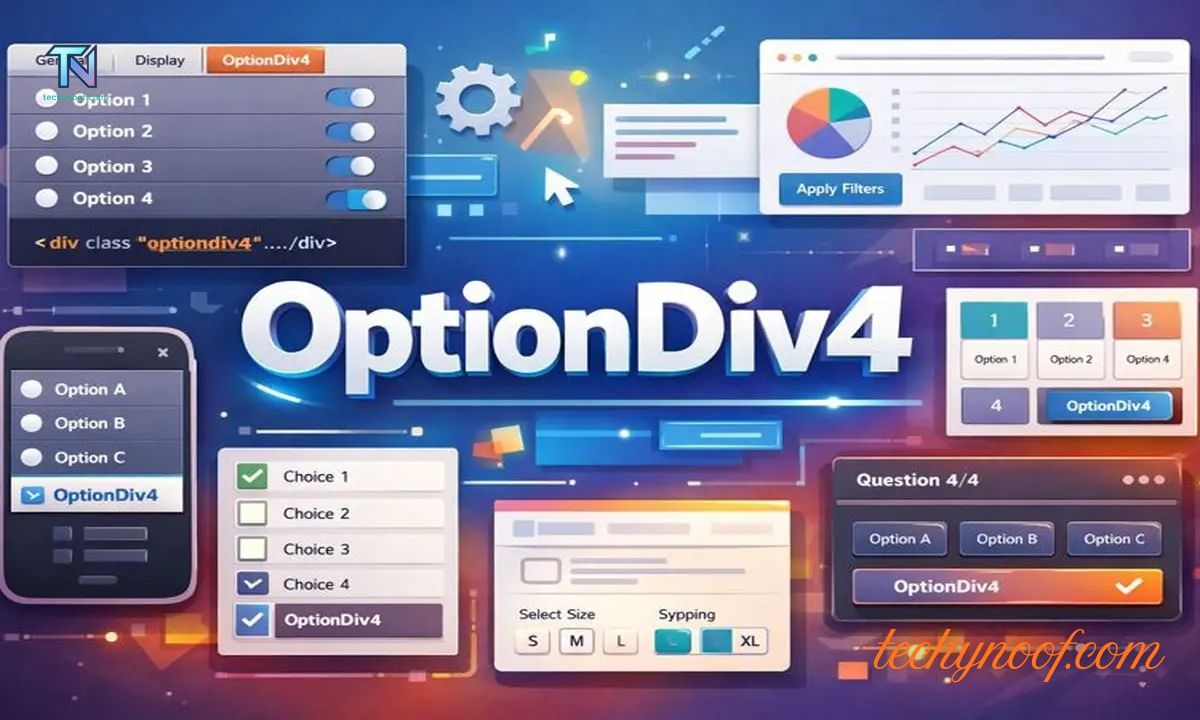
OptionDiv4 is a modular tool used in digital platforms. It organizes advanced or complex options into clean, structured blocks. This makes interfaces easier to navigate. Users see only the choices they need.
Developers save time using reusable blocks. Overall, it improves user experience and keeps platforms scalable. Many industries use Optiondiv4, from e-commerce to dashboards and workflow tools. It helps reduce clutter and simplify decisions.
Marketers, designers, and developers all benefit from it. By following best practices, platforms can implement Optiondiv4 effectively. This guide explains its meaning, uses, benefits, challenges, and implementation tips for digital systems.
What Is OptionDiv4?
OptionDiv4 is a modular interface component. It organizes advanced or dynamic options in digital platforms. Think of it as a fourth-tier division in a larger interface. Each level above it handles broader categories.
Optiondiv4 focuses on specialized or complex choices. Developers, marketers, and designers use Optiondiv4 to reduce clutter. It allows users to see only relevant options. The structure is scalable, meaning it can grow as the platform grows.
It is often used in e-commerce, dashboards, workflow automation tools, and software settings panels. OptionDiv4 is highly flexible. It can be interactive, collapsible, and customizable. It improves decision-making and makes interfaces more intuitive. Platforms benefit from cleaner architecture and enhanced user satisfaction.
Why Is OptionDiv4 Growing in Popularity?
OptionDiv4 has become popular because it solves several real problems in digital interfaces. These benefits make it appealing to developers and users alike.
1. Reduces UI clutter
Too many options on a screen confuse users. Optiondiv4 groups related choices into a clean, expandable block. This keeps interfaces simple and readable.
2. Works well with dynamic data
If your platform pulls options from APIs, databases, or user profiles, Optiondiv4 can update choices automatically. This makes it suitable for adaptive and dynamic interfaces.
3. Improves user experience
Structured option divisions guide users smoothly. They prevent errors and increase engagement. Clear hierarchies make navigation easier.
4. Helps developers maintain cleaner architecture
Developers can reuse Optiondiv4 blocks across modules. This reduces code duplication and simplifies maintenance. Changes in one block reflect everywhere it’s used.
5. Supports personalization
Marketers and product managers can customize paths for users. Optiondiv4 enables behavior-based or preference-based choices. Users see only what’s relevant to them.
How Optiondiv4 Works (Explained in Human Terms)
Optiondiv4 is easiest to understand using an analogy. Think of it as a drawer with multiple compartments. Each compartment holds a set of related options.
Users expand the compartment only when needed. This prevents visual overload. It is modular, meaning it can be moved, duplicated, or removed easily.
The “4” in Optiondiv4 refers to its position in a hierarchy:
- Core container
- Main grouping
- Sub-options
- Specialized or dynamic option block — Optiondiv4
This structure gives fine-grained control over advanced settings, conditional choices, or personalized options. Users interact only with relevant components, keeping the interface simple.
Real-World Examples of Optiondiv4 Usage
Optiondiv4 appears in many platforms. E-commerce sites use it for advanced product configurations like RAM, storage, or color options. Automation tools use it for multi-step triggers and conditional rules.
Software settings panels hide complex settings inside Optiondiv4 blocks. Dashboards use it for filters, metrics, and personalized views. It keeps interfaces clean while offering full functionality.
1. E-commerce Product Customizations
When buying a laptop, users select model, RAM, and storage first. Advanced options like BIOS settings, cooling profiles, or color themes appear in Optiondiv4 blocks. This avoids overwhelming users with too many choices at once.
2. Workflow Automation Tools
Automation platforms use Optiondiv4 for multi-step triggers, conditional logic, and advanced filters. Users see only relevant options while building complex workflows.
3. Software Settings Panels
Editing or design applications hide deep configuration options in Optiondiv4. Users expand blocks only when necessary, keeping the interface clean.
4. Dashboard Personalization
Analytics dashboards use Optiondiv4 for filters, comparison metrics, and segmentation views. This keeps dashboards uncluttered but highly functional.
Benefits of Using Optiondiv4 in Digital Platforms
OptionDiv4 improves user experience by reducing clutter and simplifying choices. It speeds up decision-making by showing only relevant options. Developers save time using reusable modular blocks.
Platforms scale easily without breaking the UI. Accessibility also improves because structured options are easier for assistive tools. Overall, it balances simplicity, efficiency, and flexibility in digital systems.
1. Better user experience (UX)
Structured options reduce confusion. Users can make decisions quickly. Interfaces feel intuitive and responsive.
2. Faster decision-making
Grouping advanced options prevents cognitive overload. Users spend less time searching for choices.
3. Developer efficiency
Reusable Optiondiv4 blocks reduce maintenance effort. Developers can update logic in one place instead of multiple modules.
4. Scalability
Platforms can grow without breaking the interface. New options can be added to Optiondiv4 blocks seamlessly.
5. Accessibility improvements
Optiondiv4 helps screen readers interpret structured options. Users with accessibility needs can navigate efficiently.
Optiondiv4 Benefits Table
| Benefit | Description | Who it Helps |
| UX improvement | Reduces clutter and simplifies choices | Users |
| Faster decisions | Groups options for clarity | Users |
| Developer efficiency | Reusable blocks for maintenance | Developers |
| Scalability | Supports growth without breaking UI | Platform owners |
| Accessibility | Clear hierarchy for assistive tools | Accessibility users |
Challenges & Limitations of Optiondiv4

Optiondiv4 can be confusing if overused. Nested blocks may overwhelm users. Poor design or unclear labels reduce its benefits. Backend logic can get more complex when handling dynamic options.
Simple interfaces do not need it. Implementation requires careful planning, testing, and thoughtful UX to ensure that it improves usability instead of adding complexity.
1. Misuse leads to confusion
Too many nested Optiondiv4 blocks overwhelm users. Balance is critical.
2. Requires thoughtful UX design
Clear labels, intuitive layout, and logical grouping are essential. Poor design negates benefits.
3. May add complexity to backend logic
Dynamic options need validation, conditional logic, and testing. Poor implementation can increase bugs.
4. Not ideal for extremely simple interfaces
Small apps with 3–4 options don’t need Optiondiv4. Overuse adds unnecessary complexity.
How to Implement Optiondiv4 Properly
Use clear, descriptive labels like “Advanced Settings.” Apply progressive disclosure, showing complex options only when needed. Make Optiondiv4 collapsible for cleaner screens.
Keep its structure consistent across modules. Add tooltips or short help texts for guidance. Test with real users to ensure clarity. Following these steps ensures Optiondiv4 improves UX and usability.
- Use clear labels – Example: “Advanced Settings,” “More Options.”
- Follow progressive disclosure – Show advanced options only when needed.
- Make it collapsible – Allow users to hide blocks for cleaner UI.
- Keep the structure consistent – Use the same logic across modules.
- Add tooltips or help text – Improve clarity and accessibility.
- Test with real users – Feedback ensures blocks are intuitive and useful.
SEO Value of Understanding Optiondiv4
Optiondiv4 is becoming a searchable term in tech, software, and UI/UX content. Articles explaining Optiondiv4 clearly can attract developers, designers, and product managers.
SEO-focused content should:
- Explain concepts in simple language
- Include real examples
- Provide actionable insights
- Answer common user questions
Content that follows EEAT (Experience, Expertise, Authority, Trustworthiness) is favored by search engines. Optiondiv4 content can build authority in tech niches.
Future of Optiondiv4: What’s Next?
OptionDiv4 will evolve with technology trends. AI-driven dynamic options may appear. Personalized selections will adapt to user behavior. Low-code and no-code tools will make it easier to implement.
Multi-device responsive support will expand. Predictive interfaces may use Optiondiv4 for smarter choices. Its role in simplifying complex systems will continue to grow in importance.
- AI-driven dynamic options
- Predictive and personalized selections
- Low-code/no-code implementation
- Fully responsive multi-device support
- Integration into automation and personalization tools
As interfaces grow more complex, modular solutions like Optiondiv4 will be essential for clarity and scalability.
Conclusion
OptionDiv4 is a modular fourth-tier component used to organize advanced options. It improves UX, reduces clutter, and supports scalable interfaces. From e-commerce systems to dashboards and workflow tools, it keeps users in control without overwhelming them.
Proper implementation ensures clarity, accessibility, and developer efficiency. Understanding Optiondiv4 is essential for modern digital design.
Frequently Asked Questions
What is the main purpose of Optiondiv4?
To organize advanced options into a clear, modular block for better UX and scalable systems.
Is Optiondiv4 a coding framework?
No, it is a modular UI/logic structure implemented via HTML, CSS, JS, or software systems.
Can beginners work with Optiondiv4?
Yes, with basic knowledge of modular logic or interface design, beginners can use it.
Is Optiondiv4 only for developers?
No, marketers, product managers, and designers also benefit from it.
Why is Optiondiv4 better than showing all options at once?
It hides complexity until needed, improving clarity and reducing cognitive load.
Is Optiondiv4 customizable?
Yes, it can be styled, extended, and adapted to any platform’s requirements.

David is the founder of techynoof.com, a site dedicated to puns and clever wordplay. He loves turning language into laughter and making words wonderfully witty.